
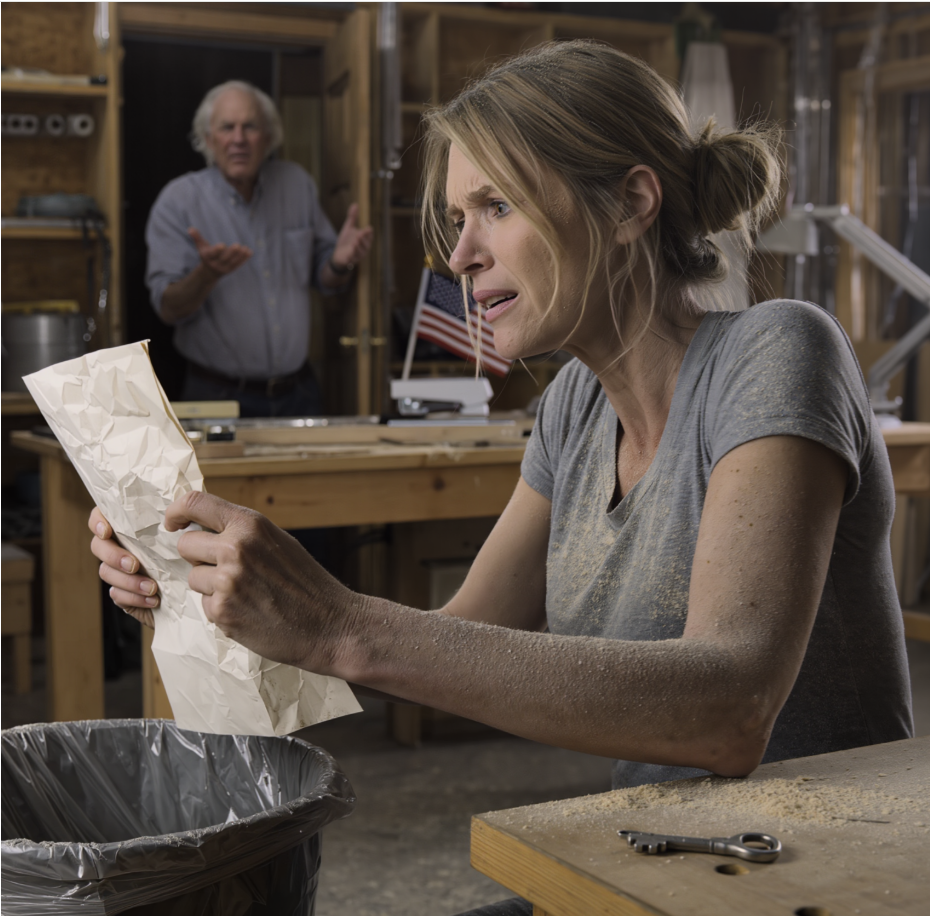
My hands were vibrating from twelve hours of sanding and welding. I was supposed to be done for the night. But my dad had leaned in the doorway earlier, arms crossed, and said, “That joint’s too far gone. You’ve got the touch. Save it.”
So I stayed. Because that’s what I did. I stayed.
I wiped my forearm across my forehead and left a streak of dust like war paint, then reached for the trash bin to empty it. The liner was heavy with blue shop towels, burnt wire scraps, and the crushed cups from the break room. As I tugged it out, something stiff and pale flashed beneath the mess.
A crumpled page.
Not an invoice.
Not a receipt.
A legal document.
I smoothed it against my workbench with the heel of my palm, and the paper fought me like it didn’t want to lay flat. The shop light caught a notary seal, the kind that looks official even when your stomach is telling you not to read another word.
DEED OF TRANSFER.
Oak & Iron Custom Metal & Woodworks.
Signed.
Notarized.
Dated.
Three years ago.
And on the line where my name should’ve been—where I’d pictured it in my head a thousand times—was my brother’s.
Adrian.
My throat went dry. The shop didn’t change, not really, but the air did. The hum of the fluorescent light got louder. Sinatra’s voice sounded farther away. Even the dust seemed to pause mid-float, like it was waiting to see what I’d do.
I didn’t scream.
I didn’t throw a tool.
I just stood there holding fifteen years of my sweat equity in one hand and my family’s betrayal in the other.
That was the moment I understood: I hadn’t been building a legacy.
I’d been working for free.
My name is Haley Crawford. I’m thirty-three. If you’re listening to this while you’re folding laundry, closing up a bar, driving home from a late shift, drop a comment and tell me where you’re listening from and what time it is for you right now. And since we’ve just stepped into 2026, I hope this new year treats you like you matter—not like you’re just the person who keeps the lights on.
Because to understand why I didn’t walk upstairs and set the house on fire with my words right then, you have to understand the architecture of my family.
My father, Sam, built Oak & Iron from a single rented bay behind a tire shop on Route 9. He always told the same origin story at fundraisers: how he came back from the service, married my mom, and decided he was going to build something “real.” Something with weight. Something you could point to.
My mother, Cynthia, ran the books and ran the room. She could glide into a Rotary Club dinner in a thrift-store dress and walk out with three new clients, two invitations, and someone else’s number saved under “Banker—Nice.”
And then there was me.
I was the kid sweeping the floor at twelve, hauling scrap at fourteen, welding my first clean bead at sixteen. I learned metal because our biggest early jobs were wrought-iron railings and custom gates. I learned wood because the “metal shop” clients always wanted matching stair treads, walnut handrails, mahogany library shelves. Oak & Iron was never just one thing. It was the kind of place people came when they wanted something built to outlast them.
I became the person who could make that happen.
I could tell you if steel was about to warp by the sound it made when it cooled. I could match the curve of a 1908 baluster by eye. I could smell the difference between red oak and white oak. I knew how to weld without scorching the grain on a handrail cap. I knew which finish to use on two-hundred-year-old wood so it didn’t look like it had been dipped in plastic.
My hands looked like a topographical map of every mistake I’d ever made and fixed—chemical burns from stripping Victorian varnish, a crescent scar across my knuckle from the day a router bit caught, calluses thick enough to strike a match on.
My brother, Adrian, had an MBA and hands as soft as a hotel pillow.
He wore Italian loafers into a shop that smelled like sawdust and solvent and hot steel. He spoke in buzzwords: synergy, scaling, pivoting, “operational efficiencies.” He could make a spreadsheet look like it belonged in a museum and couldn’t tell a chisel from a screwdriver without reading the label.
In our family, I wasn’t the star.
I was the infrastructure.
There’s a psychological term called the glass child—the sibling you look right through because they demand nothing. In business families, there’s a version of that too: the invisible workhorse. The person who becomes part of the building.
That was me.
I was the loadbearing wall. Solid. Reliable. Unnoticed.
Adrian was the chandelier—fragile, expensive, and the first thing my parents pointed at when guests came over.
They spent their energy polishing him. Funding his “ideas.” Cushioning his failures. Because they assumed I would always be there, quietly paying the electric bill with my labor.
They looked right through me because they knew I wouldn’t move.
They mistook my reliability for a lack of ambition.
That deed in the trash proved it.
Here’s the part that still makes my jaw lock when I replay it: the transfer wasn’t dated last month.
It was dated three years ago.
Not an accident.
A strategy.
If they’d told me the truth three years ago—if they’d said, “Haley, this is Adrian’s now, and you’re just the help”—I would’ve left.
And if I left, the profits would stop.
So they let me believe I was earning an inheritance. They let me grind eighty-hour weeks thinking I was investing in my own future when really I was fattening the calf for their golden child.
That was the first time the math changed.
I didn’t march upstairs. I didn’t demand an explanation. I didn’t give them the satisfaction of watching me crack.
I made a bet with myself instead.
I promised that if my family had already crowned an heir behind my back, I would stop carrying the throne on my shoulders.
And I promised that when the panic hit—and it would hit—I would let the heir handle it.
It wasn’t a dramatic vow. It wasn’t a movie speech.
It was a quiet, private contract.
Woodwork and metalwork teach you something most people forget: tension holds things together, but only up to a point.
After that, the grain doesn’t bend.
It snaps.
I didn’t snap loudly.
I snapped clean.
I set the deed down on my bench like it was contaminated. Then I looked around the shop—at the tools I’d bought with my own money because Dad said the budget was tight, at the jigs I’d built so we could duplicate antique iron scrollwork without losing the hand-forged feel, at the prototypes I’d designed after midnight while everyone else slept.
I saw my whole life sitting on a foundation of lies.
Then I waited.
At 2:00 a.m., when the house was silent—the kind of silence that makes your own breathing sound like a confession—I went to work.
I didn’t steal a single thing that belonged to Oak & Iron.
I only took what was mine.
My Lie-Nielsen chisels. My Japanese pull saws. The welding helmet I paid for myself because “the shop ones are fine.” The custom planes I’d collected like other people collect jewelry. A set of calipers so precise they felt like cheating.
Every tool had a story attached—an overtime check, a birthday money stash, a “sure, I’ll cover Saturday” that never came back to me in cash.
Then I went to the office computer.
I didn’t touch payroll.
I didn’t delete invoices.
I didn’t sabotage vendor accounts.
I simply opened the folder labeled: Haley—Custom Designs.
Every CAD file. Every blueprint for the Victorian restorations. Every template for the high-end joinery and metalwork that brought in our biggest clients.
Those weren’t company property.
They were mine.
Built on my own time.
Revised in my own head.
Paid for with my own patience.
If Adrian was the owner, surely he could design his own templates.
I removed them from the server.
Then I wiped the backups.
My finger hovered over the keyboard for one second—the last second of a fifteen-year habit.
Then I clicked.
Clean.
Final.
I walked into my father’s office and lifted the brass workshop key off the hook behind his desk. It was heavy, old, rubbed smooth by decades of hands. On the keyring was a cheap little American-flag charm I’d clipped on when I was sixteen—some plastic thing from a Fourth of July parade that had survived years of heat, dust, sparks, and sweat.
I slid the flag charm off the ring.
That tiny flag was mine.
I placed the brass key dead center on my father’s desk.
Next to it, I left a yellow sticky note with five words:
Good luck with the sawdust.
Then I walked out the back door and drove away.
I didn’t look back.
People love the idea that leaving feels triumphant, like you get a soundtrack and a slow-motion exit.
Leaving felt like stepping off a dock you’d been standing on your whole life.
Your brain expects solid.
Your body meets air.
By 7:15 a.m. the next morning, my phone started vibrating like it was possessed.
First, a text from my mother: Client is here early. Where are you?
Then a missed call from my father.
Then another.
Then another.
By 8:30, my lock screen showed 29 missed calls.
Twenty-nine.
I stared at the number like it was proof that I hadn’t imagined my own importance.
But I didn’t answer.
I sat in a diner on the edge of town with a mug of black coffee and a sweating glass of iced tea beside it, watching the waitress refill someone else’s ketchup bottle like nothing in my world had just detonated.
For the first time in fifteen years, my hands were clean.
No dust under my nails.
No metal grit stuck in the creases of my palms.
No ache in my wrists from a grinder.
And yet my forearms throbbed anyway.
Phantom pain.
My body was so conditioned to labor—the push of the plane, the resistance of steel under a hammer—that sitting still felt like losing a limb.
But when my phone lit up again and the caller ID finally switched from Mom and Dad to Adrian, I realized the pain wasn’t from losing the work.
It was from cutting off the toxic limb.
It hurt.
But the infection was gone.
Around noon, the messages shifted.
The frantic requests for blueprints turned into the familiar rhythm of gaslighting.
My mother: You are hurting the family. This is incredibly selfish. Your father is stressed and it’s affecting his heart.
Adrian: Stop being a drama queen. We don’t need your little tools. We’re pivoting to a new supplier anyway.
Then, my favorite—because it was so perfectly him it almost made me laugh.
Adrian: Send the passwords for the client database or I’ll sue you for theft.
Theft.
He was accusing me of stealing something that lived in my head.
I didn’t reply.
I didn’t defend myself.
I blocked their numbers one by one.
People always ask how you block your own family like there’s a tutorial.
Here’s the truth: you don’t block them because you hate them.
You block them because you finally love yourself enough to stop negotiating.
That was the first time I chose myself out loud.
I wish I could tell you the next part was smooth.
It wasn’t.
The first week away from Oak & Iron felt like standing on the shoulder of the interstate with nothing but a toolbox and a stubborn heart.
I stayed on my friend Marisol’s pullout couch for two nights because I didn’t trust myself alone yet. Marisol was the kind of friend who doesn’t ask questions right away. She just puts a blanket on you and sets a glass of water by the couch like she’s done it a hundred times.
The third night, she finally said, “Okay. Talk.”
So I told her.
Not with tears.
With facts.
The deed.
The date.
The signatures.
Marisol listened, jaw tight, then said, “Let me guess. You’ve been killing yourself because you thought you were earning your seat at the table.”
I nodded.
“And the seat’s already assigned,” she said.
“Three years ago,” I whispered.
Marisol leaned back and blew out a slow breath. “What are you going to do?”
I stared at my hands. Clean hands. Hands that didn’t know what to do with themselves.
“I made a promise,” I said.
“What promise?”
“That I’m done being their safety net,” I said. “When it falls apart, I’m not diving under it.”
Marisol’s eyes sharpened. “You’re serious.”
“I’ve never been more serious,” I said.
Then she did something that surprised me.
She smiled.
Not because it was funny.
Because she recognized a boundary.
“Okay,” she said. “Then we build you a life.”
The next morning, I drove to the edge of town and pulled off by an old, drafty barn I’d passed a thousand times on the way to suppliers. The siding was weather-warped. The floor was dirt in sections. The wind slid through gaps in the boards like it owned the place.
But it was dry.
And it was empty.
I called the owner from my truck and leased it on the spot with the last of my savings.
Signing that lease felt like signing my own name for the first time.
And that’s the part people don’t warn you about when you finally choose yourself: you don’t just leave a job.
You leave an identity.
In Oak & Iron, I was “Sam’s daughter.” The reliable one. The one who could be counted on.
In that barn, I was nobody.
I had to become somebody from scratch.
I spent three days leveling the floor, wiring up a generator, and setting my workbench in place while my breath fogged in the air. I set up the forge in a corner with a fireproof mat and a little prayer. I hung my clamps like they were medals. I laid out my chisels like they were scalpels.
The first time I lit the forge, the blue flame made the barn feel less like a shelter and more like a beginning.
When I made my first cut into a clean piece of timber, the sound was different.
It wasn’t the sound of labor.
It was the sound of ownership.
I named my new company the simplest thing I could: Crawford Works.
Not Oak.
Not Iron.
Just my name.
Because my name had been doing the work anyway.
Building a business involves a mountain of paperwork that has nothing to do with wood or metal.
So at night, I filed for insurance. I registered an LLC. I opened a business account at a bank where nobody knew my parents. I wrote contracts the way you learn to write boundaries—clear, specific, and not up for debate.
And then, as if the universe wanted to test whether I really meant it, my family’s mess followed me into the mailbox.
On day five, I got a certified letter.
Return receipt.
A law firm name across the top that sounded like expensive cologne.
I opened it with a flathead screwdriver because my hands don’t like paper fights.
It was from Adrian.
A demand.
A threat.
He accused me of theft of trade secrets. He demanded I return “company property,” including “digital design assets.” He claimed I had violated “fiduciary duties.” He threatened “immediate legal action.”
I read the letter twice.
Then I laughed.
Not because it was funny.
Because it was predictable.
Adrian couldn’t fix a warped gate hinge, but he could sure as hell copy-paste intimidation.
Marisol came by that night with takeout and saw the letter on my bench.
She read it, then looked up. “He’s trying to scare you.”
“I know,” I said.
“What are you going to do?”
I set the letter down and reached under my bench.
I pulled out a manila folder I’d been keeping for years.
Receipts.
For tools.
For software.
For classes I paid for myself.
For every piece of equipment my father said was “too expensive,” even as he posted photos of our work online like he’d personally carved the wood and forged the steel.
I’d never collected receipts because I planned to sue my family.
I collected them because something in me had always known.
“I’m going to respond,” I said.
“With a lawyer,” Marisol said.
“With a lawyer,” I agreed.
The next day, I called a friend from high school who’d become a commercial attorney—Dani Morgan. Dani had the kind of voice that makes people tell the truth without realizing they’re doing it.
She listened while I explained, then asked one question.
“Did you create those designs on your own time?”
“Yes,” I said.
“Did you pay for the software and equipment?”
“Yes,” I said.
“Do you have proof?”
I looked at my folder.
“Enough to make a banker blush,” I said.
Dani exhaled. “Good. Don’t panic. Don’t engage emotionally. We respond professionally.”
That’s the thing nobody teaches you: you can’t fight manipulation with explanation.
You fight it with documentation.
Dani drafted a reply that was so calm it felt like ice.
It stated that my designs were my intellectual property. It demanded Adrian cease contacting me directly. It requested that all future communication go through counsel. It reminded him that threats don’t create ownership.
We mailed it certified.
Return receipt.
Because if my brother wanted to play “official,” I could play it cleaner.
That was the first time I learned the difference between power and noise.
While that paper war was brewing, the real war was happening in the town.
Oak & Iron wasn’t just a shop.
It was a story.
And my mother controlled stories the way other people control money.
Within days, the whispers started.
I’d abandoned my father.
I’d “stolen” from the family.
I’d had a “breakdown.”
Cynthia posted on Facebook a photo of the shop sign with a caption that said: PRAYERS PLEASE. FAMILY BUSINESS GOING THROUGH A HARD TIME.
No names.
No details.
Just enough vagueness for the comment section to do her dirty work.
Marisol sent me screenshots with her own commentary in all caps.
IGNORE THEM.
I stared at the screen, then set my phone face down.
A hinge line formed in my head like a weld cooling:
They didn’t miss me. They missed my output.
And the proof came faster than I expected.
Two days later, my personal cell rang.
It wasn’t my family.
It was Richard Keller, lead architect for the Heritage Library project.
He was the man holding the keys to the $3.6 million contract my father had been bragging about for months—the contract Adrian planned to use as his victory lap.
I answered on the second ring.
“Haley,” Richard said. His voice was clipped, cold—the tone of a man who signs big checks and expects big competence. “I’m standing in your workshop. Your brother just tried to explain why we should use a chemical stain on two-hundred-year-old oak instead of the beeswax finish you specified. He called it cost-efficient.”
I closed my eyes and exhaled.
“I’m sorry, Richard,” I said. “I don’t work there anymore.”
A pause.
“I gathered that,” he replied.
Then he said the sentence that cracked something open in my chest.
“I didn’t hire a building, Haley. I didn’t hire a logo. I hired you. You are the only craftsperson in this state I trust to restore those shelves without destroying them.”
I stared at my workbench like it held answers.
“I don’t have a shop,” I said. “I don’t have the space to take on a project that size.”
“Find one,” he said.
No fluff.
No pity.
A challenge.
“I’ll advance the materials,” he continued. “I need to know right now. Are you a craftsperson… or were you just an employee?”
That question was a blade.
It cut through every excuse I’d ever used to stay.
“I’m a craftsperson,” I said.
“Good,” Richard replied. “Then act like it.”
I hung up and laughed again, but this time it wasn’t bitter.
It was adrenaline.
Because my bet was paying off.
When the heir took the crown, the clients followed the hands.
That should’ve been the end of it.
If this story was neat.
It wasn’t.
Because clients aren’t the only people who get nervous when power shifts.
Suppliers do too.
On day ten, I called Redding Steel & Supply to order stock.
I’d been buying from them for years.
The guy on the line, Paul, hesitated.
“Hey, Haley,” he said slowly. “Uh… Sam called. He said you’re not authorized to place orders anymore.”
There it was.
The sabotage.
Not dramatic.
Just small, practical, mean.
“I’m not ordering for Oak & Iron,” I said. “I’m ordering for Crawford Works. New account. New payment.”
Paul cleared his throat. “He said… you know… family stuff. He said there might be… legal issues.”
I swallowed, then kept my voice steady. “Paul, can you do me a favor? Look up my name. Look up the invoices. You’ll see who’s been paying for what.”
A pause.
Then Paul sighed like a man who’d just realized he was standing in someone else’s marriage argument.
“Send your business paperwork,” he said. “We’ll set you up.”
I thanked him.
Then I sat on an overturned bucket in my barn and let the anger roll through me like hot steel.
Because it wasn’t enough for them to take the business.
They wanted to take my access to the world.
They wanted to make me small.
That was the day I learned another hinge truth:
They can’t stop your hands. They can only try to stop your path.
So I built a new path.
I drove to a steel supplier two counties over and opened an account in person. I shook hands with strangers who didn’t know my family. I loaded my own truck. I paid with my own card.
My back ached.
My pride didn’t.
In the middle of all that, I kept getting one question from people who mattered.
“Why would you leave?”
And I kept giving the same answer.
“Because they left me first.”
The next blow came in work boots.
On day twelve, two of our old shop guys showed up at my barn.
Gus, who’d been with my dad since before I could drive.
And Tyler, a kid I’d trained to TIG weld without burning through thin stock.
They stood in my doorway awkwardly, hats in their hands like they were asking for permission to exist.
“Sam said you stole,” Gus said, not meeting my eyes.
I held still.
“And?” I said.
Gus swallowed. “He said you took designs. He said you’re trying to ruin him.”
Tyler finally looked up. “That true?” he asked.
I didn’t get defensive.
I didn’t plead my case.
I walked to my workbench and pulled open a drawer.
I took out a stack of receipts.
I handed them to Gus.
Gus’s thick fingers flipped through them slowly.
He stopped on one.
Then another.
His face changed the way a weld changes color when it cools.
“Haley,” he said quietly, “you bought half this shop.”
I let that land.
“I bought my tools,” I said. “I took my tools. I took my work. That’s it.”
Tyler shifted. “Adrian said he’s gonna bring in a CNC guy,” he said. “Says you were slowing the shop down.”
I couldn’t help it.
I snorted.
“Adrian can’t tell the difference between cold-rolled and hot-rolled steel,” I said. “But sure. He’s gonna ‘optimize.’”
Gus rubbed his jaw. “He also said… if you don’t come back… we’re all gonna get laid off.”
I stared at Gus.
Because there it was.
Not just my parents’ pride.
People’s livelihoods.
That used to be my leash.
Guilt.
Responsibility.
But I’d already made my bet.
“I’m not going back,” I said.
Gus’s shoulders sank.
Tyler’s eyes widened. “Then what are we supposed to do?”
I pointed at the barn.
“You’re standing in a shop,” I said.
They blinked.
“You’re hiring?” Tyler asked.
“I’m building,” I said. “If you want in, you come in clean. No drama. No playing both sides.”
Gus stared at my workbench. At the neat stacks of stock. At the order list taped to the wall.
“What about Sam?” he asked.
I kept my voice soft.
“Sam made his choices,” I said. “I’m making mine.”
Gus nodded slowly.
Not agreement.
Acceptance.
“We’ll think,” he said.
They left.
And I stood there alone, listening to the wind slide through the barn slats.
That was the first time I felt the weight of freedom.
It’s heavier than people think.
The night after Gus and Tyler visited, my phone buzzed again.
A new number.
I let it go to voicemail.
Then another call.
Then another.
By morning, I checked my missed calls.
Not 29 this time.
But there were enough that the number looked like a warning.
And when I finally opened my blocked messages folder, I found a string of voicemails from my mother.
Cynthia’s voice can be honey or razor depending on what she needs.
That week, it was razor wrapped in honey.
“Haley, sweetheart,” she said in one message, breathy like she was already forgiving me. “Call your father. He’s under so much stress. Don’t do this to us. We raised you.”
In the next message, the honey was gone.
“You’re being cruel,” she snapped. “People are asking questions. Do you want everyone to think you’re the kind of daughter who abandons her parents? You’re embarrassing us.”
Then she went quiet in the last voicemail.
The voice she used when she wanted me to run back like a trained dog.
“Richard Keller is here,” she said softly. “The biggest contract we’ve ever had is walking out. Your father is panicking. This is your home too, Haley. Don’t be selfish.”
My chest tightened.
Not because I was tempted.
Because she still thought the only thing I was was useful.
I deleted the voicemails.
Then I went back to work.
Two days later, my father finally got through.
I hadn’t unblocked him.
He called from a number I didn’t recognize.
I answered because some part of me still had muscle memory for obedience.
His voice came through tight and hoarse.
“Haley,” he said. “Our biggest client is leaving. Richard’s here. He says the contract is void if you aren’t on it. The bank’s calling every day. We… we need you.”
I looked around my barn. My new shop. My new life. A space that didn’t look like much yet, but it was mine.
And I heard my own voice come out calmer than I felt.
“Let the heir handle it,” I said.
Silence.
On the other end, my father inhaled like he’d been slapped.
“He doesn’t know what he’s doing,” Dad whispered.
I didn’t raise my voice.
I didn’t insult my brother.
I didn’t list the thousand fires I’d put out over the years.
I simply said, “Then you should’ve told the truth three years ago.”
“Haley—”
“I’m working,” I said.
Then I hung up.
That was the first time I didn’t rescue them.
You’d think that call would end things.
It didn’t.
Because when people lose control, they don’t suddenly become reasonable.
They escalate.
Adrian escalated first.
He didn’t show up himself. Adrian never gets his hands dirty if he can send someone else.
He sent a sheriff’s deputy.
Not with a warrant.
Not with handcuffs.
Just a polite man in a tan uniform who looked tired before he even stepped out of his cruiser.
I watched from inside my barn as the deputy walked up, boots crunching on gravel.
I opened the door.
“Ma’am,” he said, tipping his hat like he was trying to drain tension out of the air. “We got a call about possible stolen property.”
I kept my face neutral.
“From Oak & Iron?” I asked.
He sighed, just slightly. “Yes.”
I nodded. “Okay,” I said. “Come on in.”
His eyebrows lifted. He expected a fight.
I didn’t give him one.
I walked him to my workbench.
I opened my drawer.
I handed him my receipts.
He flipped through them, eyes scanning dates, amounts, item names.
Then he looked up.
“This is a civil dispute,” he said quietly.
“I know,” I said.
He cleared his throat. “I’m going to note that the property here appears to be personally purchased by you,” he said. “If they want to pursue anything, it’ll be through civil court.”
I nodded. “Thank you,” I said.
He hesitated. “Off the record,” he added, lowering his voice, “you might want to keep everything documented. People get… creative when they’re desperate.”
“I’m learning,” I said.
The deputy left.
And for the first time in a week, I felt something like satisfaction.
Not because I’d “won.”
Because I’d stayed calm.
That’s the thing about boundaries: they aren’t loud.
They’re consistent.
That night, Gus texted me.
Just two words.
We’re in.
My throat tightened.
Not because I was rescued.
Because I wasn’t alone.
Within another week, Tyler followed.
And Crawford Works stopped being a barn with a stubborn woman inside it.
It became a shop.
A real one.
With a schedule.
With a payroll.
With people who showed up because they chose to, not because they were trapped.
And that’s when Dani called me again.
“Haley,” she said, “I ran a conflict check against Oak & Iron just to make sure there are no non-compete clauses tied to your work. I found something else.”
My stomach dropped.
“Zoning?” I asked.
“No,” Dani said. “Debt.”
Silence.
Then she continued, voice lower.
“Six months ago, your brother convinced your parents to leverage the commercial property. The land. The building. The whole thing. Collateral for a high-interest business loan.”
My grip tightened on my phone.
“How much?” I asked.
“$850,000,” Dani said. “At 13.9%.”
The number hit like a hammer.
It wasn’t just stupid.
It was catastrophic.
“And the funds?” I asked.
Dani paused, then said carefully, “They were wired out to a so-called tech growth fund.”
I already knew what she was going to say.
“The crypto exchange,” I whispered.
“Yes,” Dani said.
The one that had imploded last month.
The one the news had called a “collapse,” as if collapse sounded less like theft.
The money was gone.
But the debt remained.
Dani’s voice softened. “Haley, I’m telling you because if that business goes under, they’re going to look for someone to blame. Someone to squeeze. Someone with skills. Someone with a conscience.”
I stared at the barn wall.
At my tool rack.
At the quiet evidence of my own escape.
If I had stayed—if I had swallowed my pride and accepted their future “manager” title—I would’ve spent the next twenty years paying off my brother’s gambling debt.
I would’ve been the engine on a sinking ship, shoveling coal while they steered us into an iceberg.
And for the first time since I found the deed, the anger evaporated.
It was replaced by something colder.
Relief.
I hadn’t just walked away from a job.
I’d stepped out of a burning building moments before the roof collapsed.
That was the moment the story stopped being about betrayal and became about survival.
The next day, Richard visited my barn.
Not because he wanted to inspect.
Because he wanted to see if I was real.
He arrived in a heavy coat, sharp eyes scanning the space like he was pricing risk.
“This is… rustic,” he said.
“It’s dry,” I replied.
His mouth twitched, almost a smile. “Fair.”
He walked my shop slowly. He looked at my jigs. My templates. My stock.
He paused at my forge.
“You do metal too,” he said.
“I do what the job demands,” I said.
He nodded once, then handed me a folder.
Inside was a contract amendment.
His signature line waiting.
My name printed where it belonged.
Independent contractor.
Lead craftsperson.
A material advance.
And a timeline.
I swallowed.
“This is a lot,” I said.
He met my eyes. “You’re a lot,” he replied.
I laughed—quiet, startled.
Then I signed.
The ink dried like a boundary.
Meanwhile, Oak & Iron started bleeding in public.
The library project wasn’t the only one.
The Johnson order on the time clock note—those were custom iron railings for a boutique hotel renovation. A $120,000 job. My father had promised delivery by a date he’d circled in red on his wall calendar.
Adrian tried to substitute thinner stock.
The contractor noticed.
The contractor walked.
Then the next client called.
Then another.
It wasn’t dramatic.
It was just reality.
Skill leaves.
And the business reveals what it truly is.
One afternoon, I got a call from a number I didn’t recognize.
I almost didn’t pick up.
But something told me this wasn’t family.
“Is this Haley Crawford?” a woman asked.
“Yes,” I said.
“This is Megan Johnson,” she said. “My husband and I own the Johnson Hotel Group.”
My heart stuttered.
She continued. “We’ve worked with Oak & Iron for years. We’ve always dealt with your father, but… your team always said you were the one making the magic.”
I didn’t speak.
Megan’s voice sharpened. “Oak & Iron missed three deadlines. Then your brother tried to tell my contractor the design changes were ‘strategic.’”
I could practically hear her quote marks.
“I’m sorry,” I said.
“I’m not calling for apologies,” Megan said. “I’m calling because my contractor says you’re on your own now. Is that true?”
“Yes,” I said.
“Good,” she replied. “Can you do our railings?”
I glanced at my shop schedule.
At Gus setting up a welding rig.
At Tyler measuring stock.
At my own hands.
“Yes,” I said.
Megan exhaled, satisfied. “Then send me your estimate,” she said. “And Haley?”
“Yeah?”
“Next time your father calls to guilt you,” she said, voice flat, “tell him the market doesn’t run on feelings.”
I smiled.
Because it wasn’t just my bet anymore.
Reality was collecting.
At the same time, the social fallout kept trying to drag me back.
My aunt texted from a new number.
Your mother is devastated.
Your father worked so hard.
Family is family.
Then my cousin called.
“Hey,” she said cautiously, “Mom says you’re being… harsh.”
“Is that what they told you?” I asked.
Silence.
“Haley,” my cousin whispered, “they said you stole.”
I let out a breath.
“I stole my own life back,” I said.
I could hear her swallow.
“They’re saying Dad might end up in the ER from stress,” she said.
There it was.
The emergency lever.
The button they’d trained me to hit.
I kept my voice calm.
“If he has a medical emergency, call 911,” I said. “I’m not a defibrillator.”
My cousin went quiet.
Then she said, “That’s… cold.”
“No,” I said. “That’s reality.”
I hung up.
And afterward, I sat on my shop stool and let the guilt wash over me like acid.
Because boundaries don’t erase love.
They just stop letting love be used as a weapon.
Two weeks into my new shop, my father showed up.
Not with a deputy.
Not with threats.
With exhaustion.
He stood in my barn doorway looking smaller than I’d ever seen him.
He didn’t look at my face.
He looked at my work.
At the clean welds.
At the tight joints.
At the wood grain matched like a prayer.
He recognized the quality.
It was the quality that used to pay his bills.
“We missed the Johnson deadline,” he said, voice raw. “The bank is calling every day. Your mother… she’s sick with worry. Adrian’s overwhelmed.”
I kept planing a piece of walnut. The shaving curled up in a ribbon, light and steady.
“I’m sorry to hear that,” I said.
He stepped further inside and the wind snapped the barn door behind him.
“We need you back,” he said. “We can make a deal. You come back as shop manager. We’ll give you ten percent equity.”
Ten percent.
He said it like it was generous.
Like he was handing me a prize.
I set the plane down.
“Dad,” I said quietly.
He flinched like he expected yelling.
“I know about the loan,” I said.
The color drained from his face.
He opened his mouth.
No sound.
“I know Adrian leveraged the land,” I continued. Calm. Factual. Lethal. “I know the money’s gone. I know the shop is worth less than the debt sitting on it.”
His eyes flickered.
“We can save it,” he pleaded, desperation cracking through the patriarch mask. “With your hands, with your speed, we can work our way out. It’s your heritage, Haley.”
There it was.
The hook.
Heritage.
Family.
Obligation.
In that moment, something in me unclenched.
The guilt.
The desperate need for his approval.
The fear of being called ungrateful.
It all fell away.
Because saving them would mean destroying myself.
It would mean dragging my new life into their mess and letting their bad decisions become my permanent job.
“I’m not the heir, Dad,” I said. “I never was.”
His throat worked.
“And I’m not your savior,” I added.
I looked him straight in the eye.
“I’m the competition,” I said, steady as a level. “And I’m winning.”
He stood there for a long moment, a ghost in a graveyard of his own making.
Then he turned and walked back into the cold.
I didn’t watch him go.
I went back to the work.
The next month was brutal and beautiful.
Brutal because building a shop from scratch means you do everything—craft, payroll, taxes, marketing, cleanup, customer calls, vendor negotiations, equipment repairs—sometimes all in the same hour.
Beautiful because every hour I worked now belonged to me.
Not to a ghost promise.
Not to an invisible inheritance.
To me.
Gus taught Tyler how to read a weld puddle like a language. Tyler taught our new apprentice, Lila, how to measure twice without apologizing. Marisol brought coffee and sat on a folding chair in the corner like she was guarding my peace.
And Richard Keller kept his word.
The material advance hit my account.
The first time I paid a supplier from my own business and the invoice had my name at the top, I stared at it for a full minute.
Because for so long, my name only mattered when they needed my hands.
Now it mattered on paper.
That’s when I checked my phone one morning and saw 29 new emails.
Not missed calls.
Emails.
Purchase orders.
Questions.
Schedule updates.
Twenty-nine.
The number that used to mean panic now meant work.
It felt like a joke the universe was finally telling in my favor.
Six weeks after I left, Oak & Iron went to auction.
I didn’t go to gloat.
I didn’t go to watch my parents fall apart.
I went for one reason only.
The warehouse was cold and echoing, the kind of place where sound bounces like it’s looking for somewhere to land. The auctioneer’s voice rolled through the space as strangers bought the infrastructure of my childhood for pennies on the dollar—industrial saws, dust collection systems, welding rigs, the old delivery truck my father used to wash on Sundays like it was a family pet.
I saw my parents near the exit, huddled in winter coats, arguing in low voices with Adrian. They looked small. They looked like people who had gambled their legacy on a buzzword and lost.
Adrian’s loafers were scuffed.
That detail shouldn’t have satisfied me.
It did.
When Lot 42 came up, I raised my paddle.
It was a heavy, scarred workbench made of solid maple.
Burn marks.
Gouges.
A corner worn smooth where someone had rested their hip for decades.
It wasn’t worth much to anyone else.
Too old.
Too “analog.”
But it was the bench my grandfather built by hand.
It was the bench where I cut my first dovetail.
I bought it for $300.
The auctioneer barely looked at me when he said, “Sold.”
I arranged delivery to my barn the next morning.
Then I walked out without speaking to my family.
I didn’t need their apology.
I didn’t need their acknowledgement.
Closure isn’t always a conversation.
Sometimes it’s a receipt.
Today, my barn isn’t cold anymore.
I installed radiant heating last month. The concrete stays warm even when the wind cuts across the valley like a blade. Crawford Works has a real sign now, not just a scribbled name on a piece of plywood. We have three apprentices who know that the quality of the joint matters more than the speed of the cut and that a business can’t be “pivoted” into integrity.
By my office door hangs a new brass key on a hook.
Clipped to the keyring is that same little American-flag charm.
It was there on the time clock at Oak & Iron when I still believed I was earning my place.
It was in my pocket the night I left the old key behind.
And now it swings against my own key like a quiet reminder:
Legacy isn’t something you inherit.
It’s something you build—day by day—with your own two hands.
I’m not the heir of a name.
I’m the heir of the sawdust, the steel grit, the sweat, and the silence of good work.
And for the first time in my life, I know exactly what I’m worth.
If you’ve ever been the one holding everything together while someone else gets the credit—if you’ve ever had to walk away to find your value—tell me your story below.
You aren’t alone.

Yo Make również polubił
Ignorant de l’héritage de 200 millions de dollars, la famille de sa femme a expulsé le marine américain et ses fils jumeaux de leur domicile, jusqu’à ce que leur chien d’assistance les découvre.
Mon père a oublié de raccrocher. J’ai tout entendu : « C’est un fardeau. » Je suis restée silencieuse. Vendre ma maison à 980 000 $…
Le patron de ma sœur m’a ignorée à son mariage, jusqu’à ce que je prononce une phrase qui l’a figé en plein toast…
Un milliardaire avait secrètement installé des caméras pour surveiller ses triplés paralysés. Ce qu’il a découvert sur les agissements de la femme de ménage au milieu de la nuit a complètement bouleversé ses convictions sur le contrôle et les soins.