
The old car I still drove didn’t escape either. Timothy loved pointing out how unreliable it must be, how I should think about trading it in before it left me stranded with Jordan.
He never asked how I was actually managing. He just assumed I wasn’t. I stayed quiet through all of it. Part of me hoped that if I didn’t push back, they’d eventually see I was okay. But deep down, I knew I was keeping my real life separate for a reason I wasn’t ready to share.
Jordan was watching me now, her earlier embarrassment fading into something closer to curiosity. She sensed the shift in the room, the way everyone’s eyes were on me. Timothy broke the quiet with a short, dismissive laugh—the kind that said he’d already decided I was bluffing.
“Nice try, Sarah,” he said, voice dripping with sarcasm and a fresh wave of annoyance. “But seriously—what assistant?”
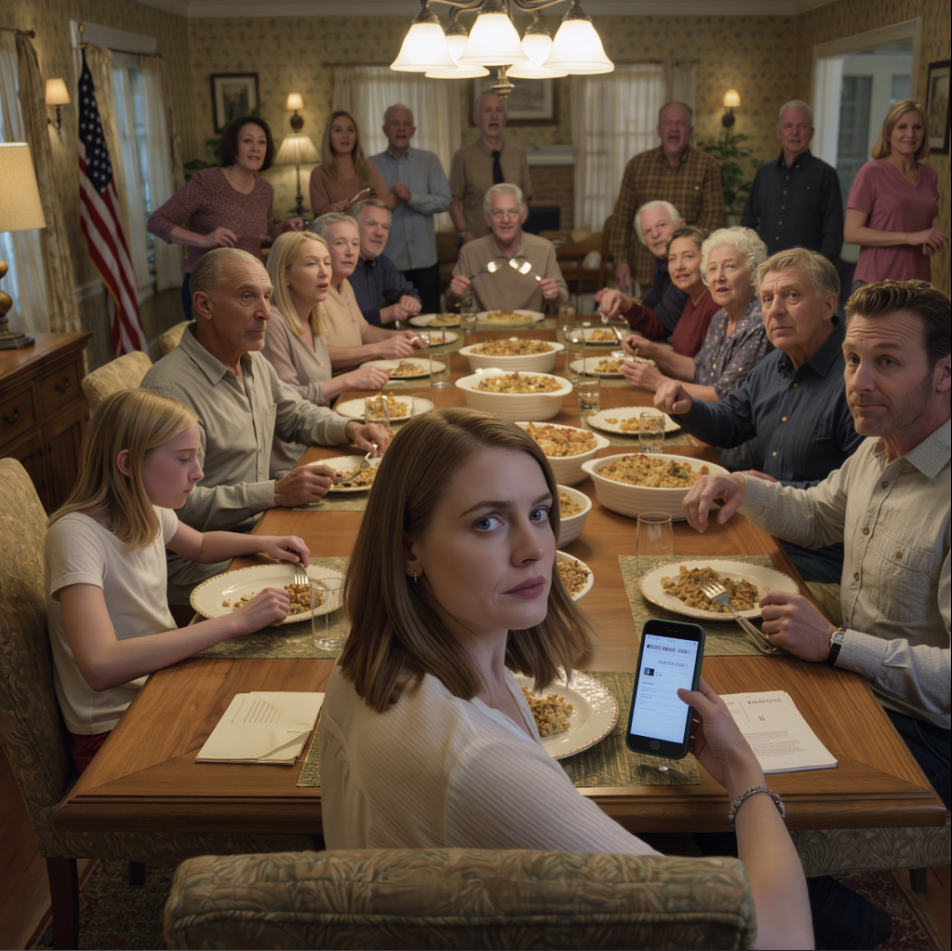
I held his gaze and reached for my phone. I placed the phone on the table, screen facing Timothy. The email was already open to an internal report from Apex Parts, the midsized auto components manufacturer I had quietly invested in years earlier. It wasn’t the kind of company that made headlines. It supplied brakes, suspension parts, and sensors to bigger distributors across the Midwest. One of those distributors—the largest, in fact—was the firm where Timothy had spent the last decade climbing the supply chain ladder.
I didn’t say anything at first. I just let him read. The report listed key accounts, delivery priorities, and pricing agreements for the upcoming quarter. Near the top under preferred partners was the name of Timothy’s employer. Next to it were notes about stable pricing and expedited orders—notes that had my initials attached from the last three board strategy meetings I’d attended virtually.
Timothy scrolled, his thumb moving faster. At first, a loud, forced laugh escaped him.
“No way,” he said, shaking his head like it was all some joke. “This can’t be real. Sarah, come on.”
But as he kept reading, the laugh died. His eyes narrowed on a section detailing client contacts. There, in black and white, was his own name listed as the primary liaison for the account. The report thanked him personally for smooth coordination over the past year and referenced decisions that had kept costs predictable—decisions I had quietly supported in board discussions to avoid disruptions during market fluctuations.
He stopped scrolling. The color drained from his face. Cynthia leaned over his shoulder, trying to see what had shut him up so completely.
“That’s—that’s just a coincidence, right?” she stammered, her voice thin. “Same name or something.”
Dad cleared his throat, but no words came out. He and Mom exchanged a quick, uneasy glance—something between confusion and the first flicker of doubt.
Across from me, Jordan’s posture changed. She had been tense all evening, shoulders hunched, but now she sat up straighter. A small, uncertain smile tugged at the corner of her mouth, and her eyes brightened as she looked at me. It was the first real spark I’d seen in her since we arrived.
The rest of the table had gone uncomfortably quiet. Cousins who had been whispering earlier now stared openly. Forks hovered, forgotten over plates. The smug energy that had filled the room minutes ago evaporated, replaced by a thick, awkward confusion.
Timothy handed the phone back without another word at first. Then he tried again, quieter this time.
“How long?” he asked, almost to himself.
I took the phone and locked the screen.
“Long enough,” I said. “I’m one of the larger shareholders in Apex Parts. I also sit on the strategic board. For the past several years, I’ve pushed to keep pricing steady and give priority routing to certain distributors—yours included—whenever the numbers got tight. It wasn’t charity. It was just good long-term business, but it did make your job a lot easier than most people in your position.”
Timothy opened his mouth, closed it, then opened it again.
“You never said anything,” he finally managed.
No, I replied. I didn’t.
Cynthia forced a nervous laugh.
“Well, this is surprising. Good for you, Sarah. Really.”
But her tone didn’t match the words.
Mom shifted in her seat, looking suddenly unsure of where to put her hands. Dad rubbed the back of his neck, eyes darting between me and Timothy. Jordan’s small smile grew a little steadier. She reached under the table and gave my hand a quick squeeze. The easy confidence everyone had walked in with was gone. In its place was a heavy, unsettled silence—the kind that comes when people realize the story they’ve been telling themselves about someone else might have been completely wrong.
Timothy leaned back in his chair, arms crossed tight, trying to look unfazed, but failing. He forced another short laugh, this one brittle.
“Okay, fine,” he said, voice tight with frustration. “You’ve got some investments. Impressive, but let’s not pretend this changes anything.”
Timothy tried to hold eye contact, but his gaze flickered away. He tried to regain his composure, his voice dropping but still unsteady.
“Why didn’t you ever say anything sooner?” he asked, questions piling up quickly. “If you’ve been part of this the whole time, why stay silent? Why let us believe you were barely getting by?”
He scanned the table for agreement, finding none.
Cynthia spoke up fast, her words protective.
“We were only trying to help Sarah. All those times we offered suggestions or stopped by—it was because we were worried. We truly wanted the best for you.”
Dad added his weight slowly.
“Family looks out for one another,” he said, though the conviction sounded thinner than usual.
Mom supported him quietly.
“That’s right. We’re meant to be there for each other no matter what.”
I paused, letting their statements hang without immediate response. When I replied, I kept it brief.
“Help in what way?” I asked evenly. “By forming opinions about my situation without ever checking the truth?”
Timothy’s frown deepened. He adjusted his posture, searching for footing.
“Sarah, you can’t seriously blame us for caring,” he insisted. “You kept everything so private. No details about work, no signs of stability. What were we supposed to think?”
Mom tried to ease the tension.
“We never wanted you handling everything solo. That’s why we stepped in when we could.”
I regarded her steadily.
“And yet no one thought to ask me straight out how things actually stood.”
Another heavy pause settled over everyone. Cynthia attempted a soft chuckle that faded quickly.
“In the end, Jordan still needed responsible adults around her. Having the whole family involved gives kids that extra layer of support.”
Jordan, who had remained unusually still, raised her head fully at the remark.
“I don’t need that kind of involvement,” she stated plainly, her voice carrying clear across the table. “I just need everyone to stop treating my mom like she’s failing at everything.”
Cynthia’s eyes widened briefly, color rising in her cheeks as she struggled for a comeback. She glanced toward Timothy, seeking backup that didn’t come right away. Timothy’s grip tightened on his water glass.
“That’s not fair,” he started heatedly, but the energy drained midway. He couldn’t summon a strong follow-up.
Dad shifted uncomfortably in his seat. Mom pressed her lips together, avoiding eye contact. The wider family stayed motionless. No cousins offered opinions. No uncles cleared throats to change the subject. Utensils remained idle on plates. The lively hum of a normal gathering had vanished completely, replaced by strained silence and averted gazes.
I didn’t press further. The straightforward questions I’d raised stood on their own, and the weak replies—or lack of them—spoke volumes.
Timothy made one last effort to redirect.
“You’re turning this into a bigger deal than it is,” he claimed, attempting firmness. The statement landed without force.
Cynthia took a slow drink, using the moment to regroup. Jordan maintained her direct gaze, the earlier shame replaced by calm determination.
The entire dinner felt irreparably altered now. Normal conversation couldn’t resume. Food sat cooling, largely uneaten. The self-assured atmosphere people brought with them had collapsed into obvious unease and withdrawal.
Timothy crossed his arms once more, cheeks still flushed. He let out a frustrated breath, fingers drumming lightly on the table. I reached for my bag under the chair. I pushed the printed board report toward the center of the table. It was a copy of the most recent strategic summary I had received, complete with agendas, voting records, and projections for the coming year. Nothing classified—just enough to show the influence I had chosen to exercise quietly until now.
Everyone’s eyes followed it. I kept my voice level.
“I’m not going to use this for financial revenge,” I said. “I won’t suddenly raise rates or cancel agreements out of spite. That’s not how I operate.”
Timothy relaxed a fraction, but only for a second.
What I am doing, I continued, is stepping back from the role I’ve played in making things easier for your company. No more quiet pushes for favorable terms when times get tight. From now on, every decision will be pure business—market rates, standard competition. No behind-the-scenes consideration.
Timothy’s expression changed. The defensiveness drained away, replaced by genuine alarm. He knew exactly what that meant. Without those subtle protections, his division would face the same pressures every other distributor did. Performance reviews would get stricter. Margins would shrink. His position—built on years of relatively smooth sailing—would be directly on the line.
He leaned forward again.
“Sarah, you can’t be serious. That would hurt a lot of people, not just me.”
I met his eyes without blinking.
“It’s not punishment,” I said. “It’s simply removing a safety net that was never owed in the first place.”
Cynthia’s hand went to her throat.
“But think about what you’re saying.”
Dad found his voice at last.
“Sarah, don’t do this to the family. We’re all connected here.”
Mom reached across the table as if to touch my arm.
“Please, honey. We can talk this through. There’s no need to go that far.”
I looked at each of them in turn.
“There’s something else,” I said. “Starting today, I’m done.”
Timothy frowned.
“Done with what?”

Yo Make również polubił
Ma sœur a pris ma robe de mariée et a épousé mon fiancé pendant que j’étais à l’étranger pour une mission de bénévolat. Mes parents ont accepté et me l’ont caché. À mon retour, quand elle l’a présenté avec suffisance comme son mari, j’ai simplement souri, car l’homme qu’elle avait épousé était…
« Pas de place pour tes gosses de supermarché à cette fête », lança ma sœur avec un sourire narquois. Les yeux de ma fille se remplirent de larmes. Mon mari regarda la famille, puis notre enfant, et sans prévenir, passa un coup de fil, se leva et prononça une phrase qui fit voler en éclats tous les verres de champagne.
On s’est moqué d’elle parce qu’elle avait enveloppé un sans-abri dans sa seule couverture pendant une tempête de neige meurtrière à Détroit ; mais le lendemain matin, quarante soldats américains se tenaient silencieusement devant son immeuble, la demandant par son nom, et personne dans la rue ne comprenait pourquoi une armée était venue chercher un enfant.
« Un millionnaire visite un orphelinat, et une petite fille le salue avec un mot qui fige tout le monde : “Papa !” »