
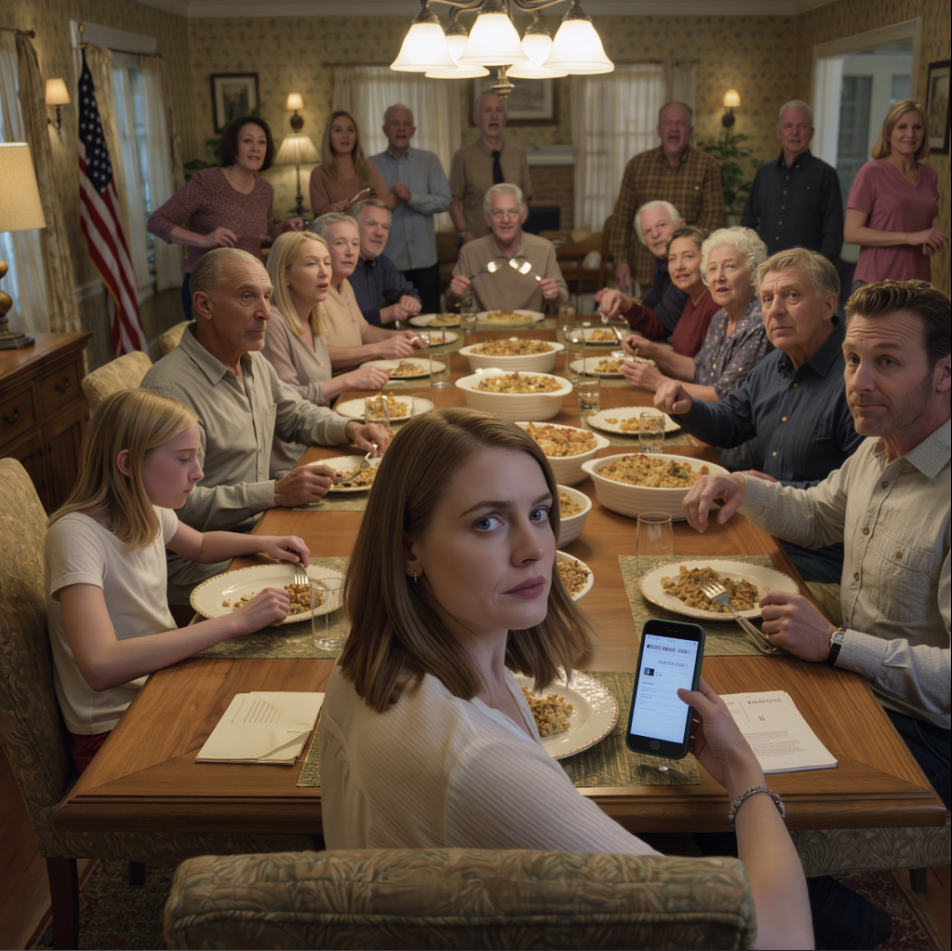
“Goodnight, Sarah,” she replied. “And for what it’s worth? That line about passing the application to your assistant? It was chef’s kiss.”
I hung up and sat in the quiet kitchen. The house didn’t feel empty the way it used to after a family gathering. It felt clean. Like I’d finally opened a window.
That night, I slept for seven straight hours. That might not sound like a victory, but for a single mom who’d spent years waking up at 3 a.m. to check bank balances and replay conversations like they were courtroom evidence, it was a miracle.
The next morning, Jordan came downstairs with her hair still damp from the shower and a cautious look on her face, like she wasn’t sure what kind of day she was allowed to have after something like last night.
“Are they going to be mad?” she asked.
“Yes,” I said, pouring her cereal. “But they’ve been mad at me in one form or another my whole life.”
Jordan nodded slowly. “Are we… are we in trouble?”
I set the spoon down and looked at her.
“No,” I said. “We’re free.”
She blinked, and for a second she looked like she might cry again. Instead, she took a bite of cereal and chewed like she was tasting a new possibility.
The first time my parents tried to reach me was three days later. I was at my desk in my home office—an office they’d never bothered to notice existed, because in their minds I was still the woman with peeling paint and a sad little yard.
My phone lit up with Mom’s name.
I stared at it until it went to voicemail.
A minute later, there was a ding. New voicemail.
I didn’t listen. Not yet. I let it sit like a closed door I didn’t owe anyone the energy to open.
Jordan came home from school, tossed her backpack by the stairs, and paused when she saw my face.
“They called, didn’t they?” she asked.
I nodded.
Jordan set her jaw. “Don’t answer.”
There was something in her voice that made my throat tighten.
“Okay,” I said.
Jordan exhaled like she’d been waiting for me to say yes.
That night, after she was asleep, I listened to the voicemail. Mom’s voice came through sweet and shaky, the way she’d always sounded when she wanted something.
“Sarah, honey, please… we need to talk. We didn’t mean—your father didn’t mean—Timothy didn’t mean… Jordan must be upset. Please call me back. We love you. We were just worried.”
Worried. That word again. The cover story they used like a blanket to smother accountability.
I deleted it.
The next voicemail came from Dad. He didn’t bother with softness.
“Sarah. This is ridiculous. You embarrassed your brother. You embarrassed your mother and me. You made a scene. Call us. We need to straighten this out.”
Straighten this out. In his mind, the problem wasn’t what he’d said. The problem was that I’d refused to absorb it quietly.
I deleted that one, too.
Timothy texted the following afternoon.
“You’re really going to do this? Over a joke?”
A joke. The janitor application was a joke. My daughter’s red face was a joke. Their smirks were a joke.
I didn’t reply.
A second text came ten minutes later.
“I’m trying to help you. Don’t be dramatic.”
I blocked his number.
The first time I blocked someone in my family, my hand shook. The second time, it didn’t.
People like to think decisions like mine are made in one big moment. The truth is, it’s hundreds of moments stacked together like bricks until you finally realize you’ve built a wall whether you meant to or not.
What my family never understood—what they couldn’t understand, because it would’ve required seeing me as a whole person—was that Apex Parts didn’t fall into my lap like a lottery ticket. It wasn’t a secret inheritance or a lucky crypto bet. It was built the same way I built everything else: quietly, stubbornly, while people were too busy dismissing me to notice.
Keith died on a Thursday.
I remember the day with brutal clarity, like my brain took a photograph and then sharpened it every time I tried to sleep. The phone call. The police officer’s careful tone. The way my hands went numb while my heart kept beating like it was trying to outrun reality.
The next morning, I woke up to the sound of Jordan singing to herself in the living room. She was four. She was coloring a picture with the concentration of someone whose world had not yet learned how to break.
I stood in the doorway and watched her for a long time, because I didn’t know how to step into that room and tell her the truth. I didn’t know how to speak a sentence that would fracture her childhood.
When I finally did, she didn’t understand. Not really. She asked when Dad would be home. She asked if the angels would bring him back.
I held her so tight my arms ached.
The funeral was a blur of casseroles and condolences and people saying the same phrases like they’d all been handed a script.
“He’s in a better place.”
“At least you have Jordan.”
“God has a plan.”
Timothy showed up with Cynthia like a couple arriving at a fundraiser. He put on the right face. He said the right words. Then he pulled me aside and said:
“If you need anything, just call.”
What he meant was: If you need to borrow money, ask nicely. If you need help, don’t be a burden. If you’re going to fall apart, do it somewhere else.
The first year after Keith died was a race between grief and survival. Insurance paid out, but not the kind of payout that changes your life. It paid the funeral. It paid some medical bills I didn’t even know existed until they started showing up in the mailbox like threats.
I had a job, but it wasn’t glamorous. I was doing contract bookkeeping for small businesses—remote work I could do after Jordan went to bed. It was steady enough to keep the lights on and the mortgage paid, but it wasn’t enough to rebuild. Not quickly.
Every night, after Jordan fell asleep, I sat at the kitchen table with my laptop and a yellow legal pad. I wrote down what we needed. I wrote down what we had. I wrote down the gap.
I hated that gap.
It made me feel like I was failing even though I was working harder than I’d ever worked in my life.
One evening, about six months in, I got a call from Keith’s old friend, Marcus Delaney. Marcus had worked with Keith in maintenance at a manufacturing plant before moving into logistics. He was one of those men who wore his grief in his shoulders.
“How you holding up?” he asked.
I almost lied, because that’s what people do when they don’t want pity.
“I’m… managing,” I said.
Marcus was quiet for a moment.
“Keith talked about you a lot,” he said. “He said you were the smartest person he knew.”
My throat tightened. “He was biased.”
“No,” Marcus said. “He wasn’t. Listen… I don’t want to overstep. But there’s something you should know.”
He told me about Apex Parts.
Back then, Apex wasn’t the steady, midsized player it is now. It was scrappy. It had a good product line and good engineers, but it was struggling with cash flow. The founder, a guy named Harold Fenton, had built the company like a craftsman builds a table: carefully, lovingly, without ever learning how to sell it to the world.
Marcus said Keith had done some side work for them—small maintenance gigs on weekends. Keith had liked Harold. Said he was the rare kind of boss who looked you in the eye when he talked.
“Harold’s looking for investors,” Marcus said. “Not hedge fund sharks. Real people. People who care about the product.”
I almost laughed.
“Marcus, I’m not an investor,” I said. “I’m a single mom trying to keep my house.”
“I know,” he replied. “But Keith… Keith said if anything ever happened, you’d figure it out. He said you could turn a spreadsheet into a weapon.”
I didn’t know whether to cry or smile.
“What are you asking me?” I said.
“Meet Harold,” Marcus replied. “Just meet him. Hear him out.”
I should’ve said no. I should’ve protected my money like a terrified animal. But something about Marcus’s voice—something about the fact that Keith had trusted him—made me listen.
I met Harold at a diner on the edge of town. He was older, white hair, hands stained with the kind of grease you don’t get from cooking. He brought a folder with him. Not a polished pitch deck. A folder.
He slid it across the table the way Timothy would later slide that job application, except Harold’s eyes weren’t smug. They were tired. And hopeful.
“I’m not trying to get rich,” Harold said. “I’m trying to keep the place alive. I’ve got forty-two people working for me. They’ve got kids. They’ve got mortgages. And we make good parts. We do. We’re not cutting corners. We just… we need stability.”
He looked at me like he could tell I understood what stability cost.
“I can’t promise you a quick return,” he continued. “But I can promise you this: I will treat your money like it matters, because it’s tied to people’s lives.”
I took the folder home and read it after Jordan went to bed. Then I read it again. Then I made my own notes.
Harold’s numbers weren’t perfect. His margins were thin. His supply chain was vulnerable. But the product quality was real, and the market demand was there.
And I could see the problem: he wasn’t negotiating like someone who believed he deserved to win.
Three days later, I met him again.
“If I invest,” I said, “I’m not investing in your parts. I’m investing in your people. I want a seat at the table. I want transparency. And I want you to stop being polite with distributors who treat you like you’re lucky they buy from you.”
Harold stared at me like I’d slapped him awake.
“Who are you?” he asked, half amused.
I smiled, just a little.
“I’m the woman who can keep your company alive,” I said. “If you let me.”
He laughed, and it wasn’t mocking. It was relieved.
That’s how it started.
Not with millions. With a modest investment that made my stomach twist for weeks, because it was money I couldn’t afford to lose. But I didn’t gamble it. I studied. I watched. I asked questions nobody wanted to answer because they were comfortable with the old way.
And slowly, Apex stabilized.
We tightened contracts. We diversified suppliers. We created predictable pricing models that rewarded long-term partners instead of opportunists. I insisted on it. Not because I wanted to be generous. Because I wanted Apex to survive storms.
The first time the board asked me to join a strategic meeting, I sat in my home office with my hair still damp from the shower, wearing a blouse on top and leggings under the desk like every working mom in America.
Harold looked into the camera and said:
“Sarah Armstrong. I want everyone to meet the woman who saved my company.”
I flinched. Not from modesty. From the fear that if my family found out, they’d circle like sharks.
That’s why I didn’t tell them.
I didn’t tell them when my dividends started coming in. I didn’t tell them when I bought my car outright instead of financing. I didn’t tell them when Apex’s valuation climbed. I didn’t tell them when I added to my stake, slowly, deliberately, until I was one of the larger shareholders.
Because I knew them.

Yo Make również polubił
« Ne viens pas à Pâques », m’a dit ma mère. « Mon nouveau mari est juge, et ta présence créerait un malaise. » Ma sœur a acquiescé d’un simple « Carrément ». Je n’ai pas protesté. Je me suis tue, les laissant croire qu’elles m’avaient de nouveau effacée de leur mémoire. Lundi matin, j’étais assise dans une salle d’audience pour un procès important. L’atmosphère était empreinte d’une confiance absolue jusqu’à ce que le juge entre… Son expression a changé instantanément lorsqu’il m’a aperçue à la table de la partie plaignante. L’avocat principal a commencé sa plaidoirie : « Votre Honneur, notre client est… » C’est alors que le nouveau mari de ma mère a compris qui j’étais. Et pourquoi j’étais là.
Laver dans une machine à laver propre ? Jetez un coup d’œil derrière ce rabat
Ma famille a manqué le mariage de ma sœur, mais ma cérémonie au château a tout changé. J’étais en train d’épingler mon voile devant le miroir de la salle de bain quand mon téléphone s’est mis à vibrer sans arrêt sur le comptoir. La lampe LED bon marché au-dessus du lavabo clignotait toutes les quelques secondes, transformant mon reflet en une version figée de moi-même : pâle, nerveuse, imposant de donner une allure de mariée à un voile à quarante dollars d’Amazon dans un appartement new-yorkais loué. L’icône de la conversation de groupe s’éclairait sans cesse. Maman. Papa. Tante Jen. Cousine Sarah. Toute ma famille envahissait mon écran comme s’il y avait une urgence. Pendant une fraction de seconde, mon cœur à bondi. Peut-être avaient-ils changé d’avis. Peut-être préparaient-ils une surprise, un geste tendre et sentimental, digne d’un film, pour montrer qu’ils tenaient vraiment à moi. Je me suis essuyée les mains sur mon legging, j’ai attrapé mon téléphone et j’ai répondu. « Hé », dis-je, un peu essoufflé. « Que se passe-t-il ? » Maman n’a même pas dit bonjour. « Lauren, il faut qu’on parle de la date de ton mariage. » J’ai eu un nœud à l’estomac. « Pourquoi ? C’est dans douze jours. » J’entendais la télévision en fond sonore, le léger bourdonnement du lave-vaisselle, les bruits de la grande maison de mes parents dans la banlieue du New Jersey. La maison où j’ai grandi, celle dont le couloir était tapissé de photos de famille brillantes : Madison aux tournois de foot, Madison au bal de promo, Madison le jour de son emménagement à la fac. Moi, sur trois photos seulement : à la maternelle, au concert de fanfare en quatrième, et sur une photo où j’apparaissais à peine, floue, derrière la couronne de Madison pour le bal de rentrée. La voix de papa s’est fait entendre ensuite, trop près du haut-parleur. « Eh bien, ma chérie, il ya eu du changement. » Le mot « changement » m’a glacé le dos. « Quel genre de changement ? » ai-je demandé. « Madison a réservé son mariage pour le même jour », dit maman, comme si elle me donnait la météo. Ma poitrine s’est affaissée. « Quoi ? »
« “Hors de ma maison”, lui lança son père quand, à 19 ans, elle tomba enceinte — Vingt ans plus tard, il resta pétrifié en se retrouvant face à face avec le général Morgan. »